
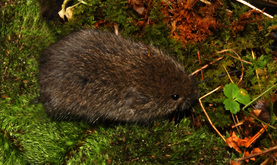

southern bog lemming
Synaptomys cooperi
What do they look like?
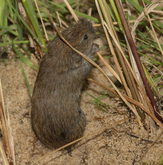
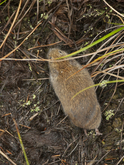
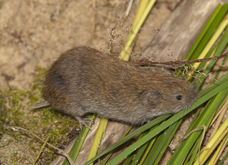
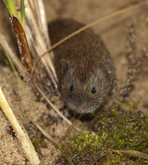
Southern bog lemmings are small voles, weighing 20 to 50 g (average 35 g) and measuring 110 to 140 mm in total length. The fur on the back ranges in color from a reddish to dark brown and has a grizzled appearance. The belly is silver-gray. They have broad incisors that are grooved, which is helps distinguish southern bog lemmings from other voles. The tail is short, barely longer than the hind foot. They have 4 toes and 1 small, nailed thumb on the forefeet and 5 toes on the hind feet. Females have 6 mammary glands, which distinguishes this species from its closest relative, northern bog lemmings, which have 8 mammary glands.
- Other Physical Features
- endothermic
- homoiothermic
- bilateral symmetry
- Sexual Dimorphism
- sexes alike
-
- Range mass
- 20 to 50 g
- 0.70 to 1.76 oz
-
- Range length
- 110 to 140 mm
- 4.33 to 5.51 in
Where do they live?
Southern bog lemmings are found in eastern North America, from southern Quebec and Manitoba in Canada to western Minnesota, to southwestern Kansas, and east to the Atlantic coast of the United States.
What kind of habitat do they need?
Southern bog lemmings occur in a wide variety of habitats. As their common name suggests, they are often found in sphagnum bogs and low moist places, but they are also found in grasslands, mixed deciduous/coniferous forests, spruce-fir forests, freshwater wetlands, marshes, and meadows. In Michigan, they can be found in clear cuts, old fields, or upland woods. They prefer areas with a thick mat of herbaceous and shrubby vegetation. They tend to live in habitats within their geographic range where they do not have to compete with meadow voles.
Southern bog lemmings use runways to travel, which are often located among roots of shrubs or beneath sphagnum moss. They also create round nests 15 to 20 cm in diameter that are made of dry leaves, grass, and some soft material like fur. Nests have 2 to 4 entrances. In the summer, nests are often placed on the ground amidst grassy vegetation or on top of sphagnum hummoks. In the winter, nests are commonly found 10 to 15 cm below the ground.
- These animals are found in the following types of habitat
- temperate
- terrestrial
- Terrestrial Biomes
- savanna or grassland
- forest
- Wetlands
- bog
How do they reproduce?
Little is known about the mating systems of southern bog lemmings.
Southern bog lemmings breed year round, especially where there is plentiful food. Most young are born between April and September. Females may have many litters in a year--one captive female bore 6 litters in 22 weeks. Females produce 2 or 3 litters per year in the wild. Pregnancy lasts from 23 to 26 days. Average litter size is 3 to 5 individuals but can range from 1 to 8. Young weigh on average 3.7 g at birth and are born blind and without fur. They also have claws at birth. By the end of their first week, young are well furred. They open their eyes at about 12 days of age. Females nurse their young for 3 weeks. Male southern bog lemmings reach sexual maturity in 5 weeks. Most individuals breed before they reach their maximum size.
- Key Reproductive Features
- iteroparous
- year-round breeding
- gonochoric/gonochoristic/dioecious (sexes separate)
- sexual
- viviparous
-
- How often does reproduction occur?
- Southern bog lemmings breed 2 or 3 times each year.
-
- Breeding season
- Southern bog lemmings breed year round.
-
- Range number of offspring
- 1 to 8
-
- Average number of offspring
- 3
-
- Average number of offspring
- 3
- AnAge
-
- Range gestation period
- 23 to 26 days
-
- Average weaning age
- 3 weeks
-
- Average age at sexual or reproductive maturity (male)
- 5 weeks
Little is known about parental investment of southern bog lemmings. Females give birth in a nest or an underground burrow, and they nurse their young for 3 weeks.
- Parental Investment
- altricial
-
pre-hatching/birth
-
provisioning
- female
-
protecting
- female
-
provisioning
-
pre-weaning/fledging
-
provisioning
- female
-
protecting
- female
-
provisioning
How long do they live?
Southern bog lemmings usually do not live for more than a year in the wild. In captivity, they may live up to 29 months.
-
- Range lifespan
Status: captivity - 29 (high) months
- Range lifespan
-
- Typical lifespan
Status: wild - 1 (high) years
- Typical lifespan
-
- Average lifespan
Status: captivity - 2.5 years
- Max Planck Institute for Demographic Research
- Average lifespan
How do they behave?
Southern bog lemmings are active throughout the day and night, but are most active during the afternoon and night. They do not hibernate and are active throughout the year, but activity is limited below -7 ˚C. Southern bog lemmings can be colonial, living in groups of a few to several dozen individuals. They often live in the same area as other species of voles, white-footed mice, deer mice, shrews and moles. Southern bog lemmings generally dominate when they encounter other voles.
Southern bog lemmings may use runways and tunnels of other species, but they often create their own. Runways are 2.5 to 5 cm in diameter and are found in heavy vegetation. They trim back new vegetation from their runways, so there is often dead grass nearby. Runways of southern bog lemmings are distinctive from those of other voles. They leave piles of grass approximately 8 cm in length next to their runways. Their droppings, which are light green in color, are also found nearby. In wooded areas, they occasionally make runways by pushing up leaf mold.
Southern bog lemmings also use tunnels and burrows. Burrows are generally located at a depth of 15 to 30 cm beneath the ground. Side chambers are used for feeding, resting, storing food, or as a nest. During the summer, their nests may be placed on the ground amidst grassy vegetation or on top of sphagnum hummoks. Nests are round, 15 to 20 cm in diameter, and have 2 to 4 exits. They are generally composed of dry leaves, grass, and some soft material like fur. Nests are often concealed under stumps or mounds of sphagnum moss.
- Key Behaviors
- terricolous
- nocturnal
- crepuscular
- motile
- sedentary
- social
Home Range
The home range of southern bog lemmings varies from .25 to 1 acre.
How do they communicate with each other?
Southern bog lemmings are thought to communicate using scent marking. They also make squeaking vocalizations.
What do they eat?
Southern bog lemmings mostly eat vegetation such as herbaceous plants, leaves, stems, seeds, particularly of bluegrass (g.Poa), white clover (<<Trifolium repens), and other grasses. They also eat sedges, mosses, fruits, fungi, bark, and roots. Bog lemmings snip stems near the ground to get access to the upper parts. Surrounding vegetation often stops the stems from falling, so additional snips must be made. Southern bog lemmings also eat some invertebrates such as slugs and snails, as well as adult and larval beetles. Their jaws are powerful and thought to be used quite often for gnawing. Captive individuals have been observed lapping up water with their tongue. Because they consume so much green vegetation, their droppings are a characteristic uniform light green in color.
- Animal Foods
- insects
- mollusks
- Plant Foods
- leaves
- roots and tubers
- wood, bark, or stems
- fruit
- bryophytes
- Other Foods
- fungus
What eats them and how do they avoid being eaten?
Southern bog lemmings have many predators, including owls, hawks, red foxes, gray foxes, domestic dogs, badgers, weasels, snakes, bobcats, and house cats.
-
- Known Predators
-
- owls (Strigiformes)
- hawks (Accipitriformes)
- red foxes (Vulpes vulpes)
- gray foxes (Urocyon cinereoargenteus)
- domestic dogs (Canis lupus familiaris)
- badgers (Taxidea taxus)
- weasels (Mustela)
- house cats (Felis silvestris)
- bobcats (Lynx rufus)
- snakes (Serpentes)
What roles do they have in the ecosystem?
Southern bog lemmings consume a variety of grasses and other vegetation and act as prey for a number of predators. They compete with other small rodents, particularly meadow voles. Meadow voles tend to out-compete southern bog lemmings. Southern bog lemmings host external parasites such as mites, lice, and fleas. The tunneling behavior of southern bog lemmings also helps mix the soil, allowing rain and air to access deeper layers and mixing vegetation and droppings with the soil, increasing its fertility.
- Ecosystem Impact
- soil aeration
- mites Acari
- lice Phthiraptera
- fleas Siphonaptera
Do they cause problems?
In areas of high populations, increased tunneling activities of southern bog lemmings may be a nuisance in yards in wet areas. There are otherwise no known adverse effects of southern bog lemmings on humans.
How do they interact with us?
There are no known direct positive effects of southern bog lemmings on humans. Because they are important prey for many species and they aerate the soil, they help maintain a thriving ecosystem.
Are they endangered?
Once very common, numbers of southern bog lemmings seem to be declining as a result of habitat destruction and the overgrowth of bogs. This rate of decline is not fast enough for the species to be considered threatened. Southern bog lemmings are widespread and they currently have no major threats. Some human activities such as deforestation and elimination of grassland change habitats. Although these changes helps Microtus, they put southern bog lemmings at risk because Microtus tend to out-compete southern bog lemmings. Two subspeices of southern bog lemmings are currently extinct: Kansas bog lemmings (Synaptomys cooperi paludis) and Nebraska bog lemmings (S. cooperi relictus).
-
- IUCN Red List
-
Least Concern
More information
-
- IUCN Red List
-
Least Concern
More information
-
- US Federal List
- No special status
-
- CITES
- No special status
-
- State of Michigan List
- No special status
Contributors
Tanya Dewey (editor), University of Michigan-Ann Arbor, George Hammond (editor), Animal Diversity Web Staff, Gail McCormick (editor), Animal Diversity Web Staff.
Allison Poor (editor), University of Michigan-Ann Arbor.
Bridget Fahey (author), University of Michigan-Ann Arbor.
References
Nowak, R.M. Walker's Mammals of the World, 5th Edition. Johns Hopkins University Press.
Linzey, A. V. 1983. Syamptomys cooperi. Mammalian Species, no. 210: 1-5.
Kurta, A. 1995. Mammals of the Great Lakes Region. University of Michigan Press, Ann Arbor MI
"Animal Life Histories Database" (On-line).
Linzey, A., G. Hammerson. 2008. "Synaptomys cooperi" (On-line). IUCN Red List of Threatened Species Version 2010.4. Accessed March 30, 2011 at http://www.iucnredlist.org/apps/redlist/details/42639/0.
Schwartz, C., E. Schwartz. 2001. The Wild Mammals of Missouri. Columbia, Missouri: University of Missouri Press.
Wilson, D., S. Ruff. 1999. The Smithsonian Book of North American Mammals. Washington [D.C.]: Smithsonian Institution Press in association with the American Society of Mammalogists.


BioKIDS home | Questions? | Animal Diversity Web | Cybertracker Tools
Fahey, B. 2011. "Synaptomys cooperi" (On-line), Animal Diversity Web. Accessed April 25, 2024 at http://www.biokids.umich.edu/accounts/Synaptomys_cooperi/BioKIDS is sponsored in part by the Interagency Education Research Initiative.
It is a partnership of the University of Michigan School of Education, University of Michigan Museum of Zoology, and the Detroit Public Schools. This material is based upon work supported by the National Science Foundation under Grant DRL-0628151.
Copyright © 2002-2024, The Regents of the University of Michigan. All rights reserved.
