

Chilopoda
What do they look like?
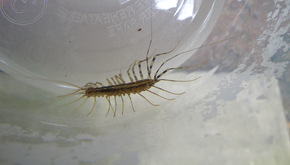
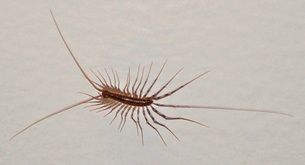
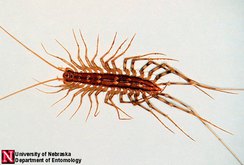
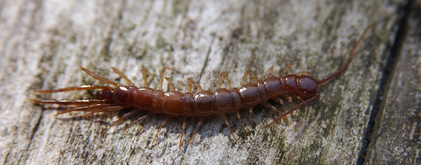
Centipedes have long, segmented bodies, covered in a tough, flexible exoskeleton. Each segment has one pair of legs, and there is a pair of antennae on their heads. At the head, one pair of legs is modified to work as fangs that bite and deliver venom. Often the last pair of legs are used like antennae too, used for sensing instead of walking. Most centipedes are flat, with short legs, but there are few that have rounded bodies and very long legs.
- Other Physical Features
- bilateral symmetry
- Sexual Dimorphism
- sexes alike
Where do they live?
There are thousands of species of centipedes all around the world.
- Biogeographic Regions
- nearctic
- palearctic
- oriental
- ethiopian
- neotropical
- australian
What kind of habitat do they need?
Most centipedes need to live in moist places, but a few can survive in deserts and dry grasslands.
- These animals are found in the following types of habitat
- temperate
- tropical
- terrestrial
- Terrestrial Biomes
- taiga
- desert or dune
- chaparral
- forest
- rainforest
- scrub forest
- mountains
How do they grow?
Baby centipedes hatch out of their eggs looking like small versions of grown-up centipedes. As they grow they shed their exoskeleton to make room.
How long do they live?
Most centipedes probably only live for a year or two at most, but some may live for several years
-
- Typical lifespan
Status: captivity - 1.0 to 3.0 years
- Typical lifespan
How do they behave?
Most centipedes are not social, they almost always found alone. A few are found in groups.
How do they communicate with each other?
Centipedes have pretty simple eyes, they probably communicate mostly through touch and smell. They can feel vibrations.
What do they eat?
Centipedes are active hunters. They roam around looking for small animals to bite and eat. They eat insects, spiders, and other small invertebrates. If the centipede is large enough it will even attack small vertebrates like lizards.
- Primary Diet
-
carnivore
- eats terrestrial vertebrates
- eats non-insect arthropods
What eats them and how do they avoid being eaten?
Centipedes mainly avoid predators by hiding under bark, rocks, or in dead leaves, or burrowing in soil. Many species can run fast. They will also bite to protect themselves.
Are they endangered?
No centipede species are known to be endangered.
-
- IUCN Red List [Link]
- Not Evaluated
Some more information...
There are 26 species of centipedes known to occur in Michigan, but there could be more, many species of centipedes are still unknown to science
Contributors
George Hammond (author), Animal Diversity Web.


BioKIDS home | Questions? | Animal Diversity Web | Cybertracker Tools
Hammond, G. . "Chilopoda" (On-line), Animal Diversity Web. Accessed April 26, 2024 at http://www.biokids.umich.edu/accounts/Chilopoda/BioKIDS is sponsored in part by the Interagency Education Research Initiative.
It is a partnership of the University of Michigan School of Education, University of Michigan Museum of Zoology, and the Detroit Public Schools. This material is based upon work supported by the National Science Foundation under Grant DRL-0628151.
Copyright © 2002-2024, The Regents of the University of Michigan. All rights reserved.
