

Diplopoda
What do they look like?
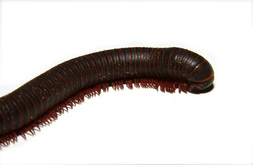
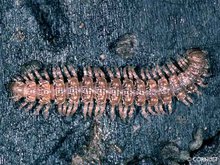
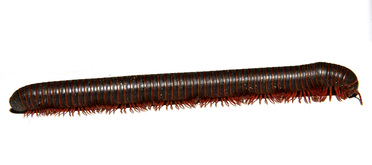
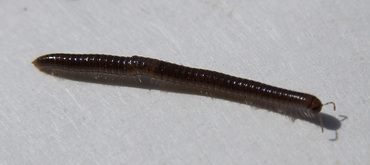
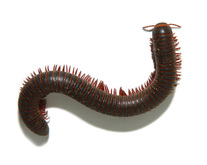
These invertebrates have long thin bodies made of many segments, protected by an exoskeleton. Each segment has two pairs of legs. They have a pair of antennae on their head, and chewing mouthparts. Most have glands along their body that make toxic compounds to discourage predators. Most millipedes are darkly colored, but some very toxic ones are bright.
- Other Physical Features
- bilateral symmetry
- Sexual Dimorphism
- sexes alike
Where do they live?
Millipedes are found all over the world, and are most diverse in the humid tropical regions.
- Biogeographic Regions
- nearctic
- palearctic
- oriental
- ethiopian
- neotropical
- australian
What kind of habitat do they need?
Millipedes live on land, but they need to live in moist places, and most live in forested areas (though there are plenty in grasslands and other habitats too)
- These animals are found in the following types of habitat
- temperate
- tropical
- terrestrial
- Terrestrial Biomes
- taiga
- chaparral
- forest
- rainforest
- scrub forest
- mountains
How do they grow?
Millipedes don't change their structure much as they grow. Babies look like small adults. As they grow they shed their exoskeleton to make more room.
How do they behave?
Millipedes are not usually social. They become active when it is not to bright or dry.
- Key Behaviors
- nocturnal
- crepuscular
- motile
- sedentary
- solitary
How do they communicate with each other?
Millipedes have very poor vision. They probably communicate with touch and smell. A few species glow in the dark, probably to warn predators that they are poisonous.
What do they eat?
Millipedes eat dead plant material. They have bacteria and other microbes in their digestive system that helps them break down the dead leaves and other foods they eat. They sometimes eat the dung of herbivores.
- Primary Diet
- herbivore
What eats them and how do they avoid being eaten?
Millipedes can't run fast, so they have protection. They curl up to protect their legs, and they give off toxic chemicals to poison their predators or at least taste bad.
What roles do they have in the ecosystem?
Millipedes can be important decomposers, especially in tropical forests.
- Ecosystem Impact
- biodegradation


BioKIDS home | Questions? | Animal Diversity Web | Cybertracker Tools
. "Diplopoda" (On-line), Animal Diversity Web. Accessed April 27, 2024 at http://www.biokids.umich.edu/accounts/Diplopoda/BioKIDS is sponsored in part by the Interagency Education Research Initiative.
It is a partnership of the University of Michigan School of Education, University of Michigan Museum of Zoology, and the Detroit Public Schools. This material is based upon work supported by the National Science Foundation under Grant DRL-0628151.
Copyright © 2002-2024, The Regents of the University of Michigan. All rights reserved.
