
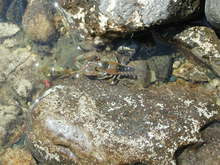

northern clearwater crayfish
Orconectes propinquus
What do they look like?
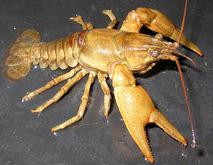
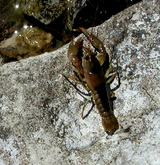
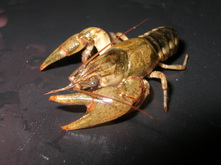
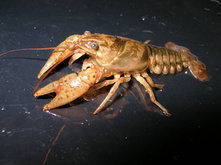
Northern Clearwater Crayfish have one pair of robust claws and are dark reddish brown. Behind the claws they have 10 walking legs. They have a dark band or stripe that runs along the midline of their carapace (shell). Their coloration makes them difficult to see in their rocky, underwater habitat. Adults may reach a carapace length of 18 to 22 mm, and a total length of 60 to 120 mm.
- Other Physical Features
- ectothermic
- bilateral symmetry
- Sexual Dimorphism
- sexes alike
-
- Range length
- 60.0 to 120.0 mm
- 2.36 to 4.72 in
Where do they live?
Northern Clearwater Crayfish are native to the Great Lakes Region of North America.
What kind of habitat do they need?
Northern Clearwater Crayfish are found in clear, rocky streams and the rocky shores and riffles of lakes.
- These animals are found in the following types of habitat
- temperate
- freshwater
- Aquatic Biomes
- lakes and ponds
- rivers and streams
How do they grow?
Depending on water temperature, Northern Clearwater Crayfish eggs hatch in 3 to 6 weeks after being laid. Young crayfish will undergo 3 to molts while attached to their mother's swimming legs (swimmerets) and remain with their mother for several weeks. Once the young have left their mother, they undergo 8 to 10 more molts before becoming mature. This usually happens in their second year of life when they reach about 4.4 cm long. After becoming mature, adult males will molt twice yearly and females molt once yearly.
How long do they live?
Northern Clearwater Crayfish may live to be 3 to 4 years old.
-
- Average lifespan
Status: wild - 3.5 months
- Average lifespan
How do they behave?
Northern Clearwater Crayfish excavate burrows in which to hide. They are active mainly during the day, taking refuge in their burrows at night. Northern Clearwater Crayfish forage among the rocks and debris along the bottom of the lakes and streams in which they live.
How do they communicate with each other?
Northern Clearwater Crayfish live in clear water environments, so are mostly active during the day and use their vision to find prey much more than other, related crayfish species. They also respond to chemical cues and to touch. Other crayfish give off an alarm odor when they encounter a predator, the presence of this alarm odor makes neighboring crayfish more likely to respond with alarm to things that they see or feel.
What do they eat?
Northern clearwater crayfish feed on insects, snails, other invertebrates, aquatic plants, and algae.
- Primary Diet
- omnivore
What eats them and how do they avoid being eaten?
The primary predators of crayfish young and eggs are other crayfish and fish. Most adult crayfish are preyed on by large fish, otters, raccoons, mink, and great blue herons. Northern clearwater crayfish, and other crayfish, escape from predators with a "tail-flip" response. This is a rapid flip of their tail segments which sends them quickly through the water in the opposite direction from where they detected the disturbance. The presence of other crayfish that have just been alarmed by a predator will make crayfish more likely to use the tail-flip response than otherwise.
What roles do they have in the ecosystem?
Northern Clearwater Crayfish provide an important food source for their predators and act to control the populations of their prey species.
How do they interact with us?
Humans benefit from the presence of Northern Clearwater because they help to support populations of their predators, such as large game fish.
Are they endangered?
As of 1996 the conservation status of Northern Clearwater Crayfish was considered stable. However, the introduction of a non-native crayfish, the Rusty Crayfish, in the Great Lakes region may ultimately cause problems for Northern Clearwater Crayfish. These two crayfish are closely related and may hybridize (mate between species), changing the genetic continuity and possibly the ecological interactions of Northern Clearwater Crayfish.
-
- IUCN Red List [Link]
- Not Evaluated
Some more information...
Another common name for crayfish is crawfish or crawdad.


BioKIDS home | Questions? | Animal Diversity Web | Cybertracker Tools
. "Orconectes propinquus" (On-line), Animal Diversity Web. Accessed April 27, 2024 at http://www.biokids.umich.edu/accounts/Orconectes_propinquus/BioKIDS is sponsored in part by the Interagency Education Research Initiative.
It is a partnership of the University of Michigan School of Education, University of Michigan Museum of Zoology, and the Detroit Public Schools. This material is based upon work supported by the National Science Foundation under Grant DRL-0628151.
Copyright © 2002-2024, The Regents of the University of Michigan. All rights reserved.
