
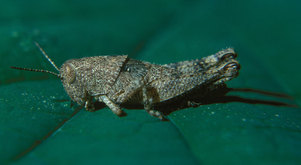
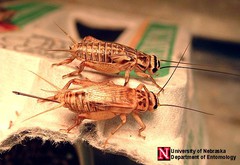
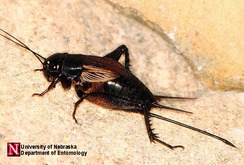
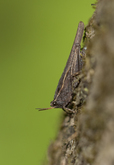
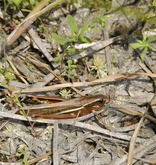

Local animals in this group:
grasshoppers and relatives
Orthoptera
What do they look like?
The common characteristic of these groups their enlarged back legs that they use for jumping. They all have chewing mouthparts too. Most species have leathery front wings, and use their back wings for flying.
- Other Physical Features
- ectothermic
- bilateral symmetry
- polymorphic
- Sexual Dimorphism
- female larger
Where do they live?
Species in this group of insects occur on every continent except Antarctica. There are thousands of species in these groups.
- Biogeographic Regions
- nearctic
- palearctic
- oriental
- ethiopian
- neotropical
- australian
- oceanic islands
What kind of habitat do they need?
These insects occur in just about all the habitats on earth, except in the extreme cold of ice sheets and high mountaintops. There are even some that swim and eat plants underwater!
- These animals are found in the following types of habitat
- temperate
- tropical
- terrestrial
- freshwater
- Terrestrial Biomes
- taiga
- desert or dune
- chaparral
- forest
- rainforest
- scrub forest
- mountains
- Aquatic Biomes
- lakes and ponds
How do they grow?
Orthopterans are hemimetabolous. Females lay eggs, and the babies that hatch out are called nymphs. They look a lot like the adults. As they grow they shed their exoskeleton (usually 5 or 6 times). The last time they shed they emerge as adults, and not until then do they have wings. In temperate climates with cold winters, it is usually the egg stage that survives the winter, though a few species survive the winter as nymphs or adults.
How do they reproduce?
- Mating System
- monogamous
- polygynous
- Key Reproductive Features
- semelparous
- iteroparous
- seasonal breeding
- year-round breeding
- parthenogenic
- sexual
- fertilization
- oviparous
- sperm-storing
- Parental Investment
- no parental involvement
How do they behave?
Do they cause problems?
- Ways that these animals might be a problem for humans
- crop pest


BioKIDS home | Questions? | Animal Diversity Web | Cybertracker Tools
. "Orthoptera" (On-line), Animal Diversity Web. Accessed May 15, 2024 at http://www.biokids.umich.edu/accounts/Orthoptera/BioKIDS is sponsored in part by the Interagency Education Research Initiative.
It is a partnership of the University of Michigan School of Education, University of Michigan Museum of Zoology, and the Detroit Public Schools. This material is based upon work supported by the National Science Foundation under Grant DRL-0628151.
Copyright © 2002-2024, The Regents of the University of Michigan. All rights reserved.
