
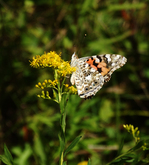

Vanessa cardui
What do they look like?
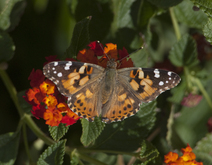
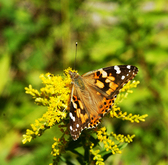
Adults of Vanessa cardui are about 5.1 to 7.3 cm in length. The upper side of their wings are orange-brown. The front wings have a white bar, and the rear wings have a row of five tiny black dots. The underside of their wings have brown, black,and gray patterns with tiny spots.
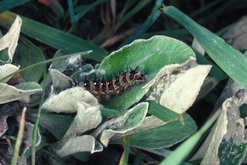
Eggs of the Painted Lady appear to be pale green in color. Caterpillars are grayish brown and darker at the ends. They have a yellow stripe running down the back of their body, and spikes along the back and sides of their body. Pupae can be a variety of colors including a metallic green, brown, or bluish-white. ("Attributes of Vanessa cardui", 2013; Brian, 1990; Pyle, 1981)
- Other Physical Features
- ectothermic
- heterothermic
- bilateral symmetry
- Sexual Dimorphism
- sexes alike
-
- Range length
- 5.1 to 7.3 cm
- 2.01 to 2.87 in
-
- Average length
- 6.4 cm
- 2.52 in
-
- Range wingspan
- 5.1 to 7.3 cm
- 2.01 to 2.87 in
-
- Average wingspan
- 6.4 cm
- 2.52 in
Where do they live?
Painted ladies (Vanessa cardui) are one of the most widely distributed species of butterfly. They can be found on every continent in the world except Antarctica and Australia. The territory size of the Painted Lady is large enough to cover all of North America, south to Panama. They are also in Asia, Africa, and Europe. ("Attributes of Vanessa cardui", 2013; Orsak, 1977; Painter, 2013)
- Biogeographic Regions
- nearctic
- palearctic
- oriental
- ethiopian
- neotropical
- oceanic islands
What kind of habitat do they need?
Painted Ladies live in areas with wide open areas of plants such as fields and meadows. They can also be found in suburban, agricultural, swamp, bog, marsh, tundra, taiga, desert or dune, chaparral, forest, rainforest, scrub forest, and mountain habitats as well. These butterflies can adjust to living in pretty much any habitat. ("Attributes of Vanessa cardui", 2013; Orsak, 1977; Painter, 2013)
- These animals are found in the following types of habitat
- temperate
- tropical
- terrestrial
- Terrestrial Biomes
- tundra
- taiga
- desert or dune
- savanna or grassland
- chaparral
- forest
- rainforest
- scrub forest
- mountains
- Other Habitat Features
- urban
- suburban
- agricultural
- riparian
How do they grow?
Painted Lady butterflies go through complete metamorphosis, and have the life stages of egg, larva (also known as caterpillars), pupa, and adult. Females lay eggs on a plant, which the caterpillars will eat once they hatch. The caterpillars also build tents out of silk on the plant. They shed their skin several time over the next few weeks before becoming pupae. As a pupa, the caterpillar forms a cocoon, and its body shape will completely change during this time. Once pupation is complete, it emerges as an adult butterfly. The time of development from egg to adult depends on where they are in the world. Those in warmer, tropical areas will develop in 33 to 44 days. In cooler climates, development can take more than 60 days. ("Attributes of Vanessa cardui", 2013; Orsak, 1977; Stefanescu, et al., 2013)
- Development - Life Cycle
- metamorphosis
How do they reproduce?
Painted lady males have territories that they defend from other males. When a female crosses paths with a male, the male will then court the female in hopes that she will mate with him. Males will mate with multiple females during their lives. (Painter, 2013; Saul, 1994)
- Mating System
- polygynous
Painted ladies will mate year round in warm climates, but do not mate during the winter in cooler places. Females will lay about 500 eggs, each egg singly laid on a plant that the caterpillar will eat when it hatches. Both male and females are able to mate 5 to 7 days after emerging from their cocoons. Mating and reproduction also take place throughout the mass migrations that this species undertakes, producing multiple generations throughout the migration. In laboratories, scientists have seen up to 8 generations in a year. (Painter, 2013; Saul, 1994; Stefanescu, et al., 2013)
- Key Reproductive Features
- iteroparous
- year-round breeding
- gonochoric/gonochoristic/dioecious (sexes separate)
- sexual
- fertilization
- oviparous
-
- How often does reproduction occur?
- Painted ladies breed year round, climate permitting.
-
- Breeding season
- Mating takes place year round, except in cooler areas where it stops in the fall and winter.
-
- Average eggs per season
- 500
-
- Range gestation period
- 20 to 25 days
-
- Range age at sexual or reproductive maturity (female)
- 5 to 7 days
-
- Range age at sexual or reproductive maturity (male)
- 5 to 7 days
Females provide nutrients in the eggs, and also lay their eggs on plants that the caterpillars will eat when they hatch. After the eggs are laid, the females leave and do not return. (Painter, 2013; Saul, 1994)
- Parental Investment
-
pre-hatching/birth
-
provisioning
- female
-
provisioning
How long do they live?
Painted ladies live about a year, from egg to death. Adults live for about 10 to 24 days after emerging from their cocoons. (Stefanescu, et al., 2013)
-
- Average lifespan
Status: wild - 1 years
- Average lifespan
How do they behave?
Every year, painted lady butterflies make huge migrations from Africa to Europe and back again. They also do this in North America, from Mexico to northern United States and Canada and back again. The migrations can be up to 15000 km long. In the spring, they begin moving north as the temperatures become too warm in Africa or Mexico. Along the way, they mate and reproduce. Since most adult butterflies do not live more than a month, it is not just one generation of butterfly that makes this migration. Instead, it is their offspring and their offsprings' offspring that make the journey. Millions of butterflies can make this journey, though some years there are far less. They reach the northern parts of Europe and North America during the summer, when temperatures are just right for the butterflies. They continue to reproduce, and then they start flying back south in late summer and fall, when temperatures become too cold in the north. ("Attributes of Vanessa cardui", 2013; Stefanescu, et al., 2013)
Home Range
During migrations, populations of painted ladies can move thousands of kilometers. (Stefanescu, et al., 2013)
How do they communicate with each other?
Painted lady butterflies communicate with other butterflies through movement, chemicals, vision, and sound. Caterpillars have poor vision, but they can see red through ultraviolet. Adults have better eyes that let them identify food and mates. ("Life cycle of a butterfly", 2003; Pyle, 1981)
What do they eat?
Painted lady butterflies feed on many different plants. Adults eat nectar from flowers, such as aster, cosmos, blazing star, iron weed, joe-pye, red clover, button bush, privet, milkweeds, and thistles. Caterpillars eat the leaves from plants such as cheeseweed, thistles, dwarf nettle, lupine, fiddleneck, and many different members of the daisy family. ("Attributes of Vanessa cardui", 2013; Stefanescu, et al., 2013)
- Primary Diet
- herbivore
- Plant Foods
- leaves
- nectar
What eats them and how do they avoid being eaten?
Predators of painted ladies include birds, bats, ants, wasps, and spiders. Adult painted ladies escape from predators by flying away, and their colors also work as camouflage. ("Attributes of Vanessa cardui", 2013)
- These animal colors help protect them
- cryptic
-
- Known Predators
-
- birds, Aves
- bats, Chiroptera
- ants, Formicidae
- wasps, Hymenoptera
- spiders, Araneae
What roles do they have in the ecosystem?
Painted ladies pollinate the plants and flowers in their habitat. Painted ladies have been recorded feeding from more than 100 plant species, so they can have a big effect on many plant species. Painted ladies are also a part of the food web, since they are eaten by birds, bats and other insects. They can also be used by a large variety of parasites. The parasites attack both the caterpillars and the pupae, using the bodies of the painted ladies for their own development. These parasites include tachinid flies (Exorista segregata and Sturmia bella), ichneumonid wasps (Thyrateles camelinus, Cotesia vanessae, Cotesia vestalis and Dolichogenidea sicaria), and chalcid wasps (Pteromalus puparum). ("Attributes of Vanessa cardui", 2013; Stefanescu, et al., 2012)
- Ecosystem Impact
- pollinates
- thistles, Asteraceae
- hollyhock, Alcea
- mallow, Malvaceae
- milkweed, Asclepias
- aster, Asteraceae
- legumes, Fabaceae
- tachinid fly, Exorista segregata
- tachinid fly, Sturmia bella
- ichneumonid wasp, Thyrateles camelinus
- ichneumonid wasp, Cotesia vanessae
- ichneumonid wasp, Cotesia vestalis
- ichneumonid wasp, Dolichogenidea sicaria
- chalcid wasp, Pteromalus puparum
Do they cause problems?
Caterpillars of this species sometimes eat beans, artichokes, and mint. These are plants that humans use, so it causes problems when the caterpillars eat the plants and destroy them. (Orsak, 1977)
- Ways that these animals might be a problem for humans
- crop pest
How do they interact with us?
Painted lady butterflies pollinate plants when they feed on the nectar. Some of these plants may be plants that humans use, so by pollinating them, the butterflies help the plants reproduce, which is helpful to humans. Butterflies are also an important species to study, since changes in butterfly populations can show that there are changes in the ecosystem. If the number of butterflies decreases, scientists will know to look for bad changes in the ecosystem, such as pollution or habitat loss. (Painter, 2013)
- Ways that people benefit from these animals:
- pollinates crops
Are they endangered?
Painted lady butterflies are not an endangered species.
-
- IUCN Red List
- Not Evaluated
-
- US Federal List
- No special status
-
- CITES
- No special status
-
- State of Michigan List
- No special status
Contributors
Rachel Kreiger (author), Bridgewater College, Cody Noblitt (author), Bridgewater College, Tamara Johnstone-Yellin (editor), Bridgewater College, Angela Miner (editor), Animal Diversity Web Staff.
References
2013. "Attributes of Vanessa cardui" (On-line). Butterflies and Moths of North America. Accessed March 29, 2014 at http://www.butterfliesandmoths.org/species/Vanessa-cardui.
2003. "Life cycle of a butterfly" (On-line). Earth's Birthday Project. Accessed March 29, 2014 at http://earthsbirthday.org/butterflies/butterfly-lifecycle.
2014. "Painted lady" (On-line). About Insects. Accessed March 29, 2014 at http://insects.about.com/od/butterfliesmoths/p/Vcardui.htm.
Brian, C. 1990. "Painted lady" (On-line). Accessed March 29, 2014 at http://www.massaudubon.org/learn/nature-wildlife/insects/butterflies/find-a-butterfly/%28id%29/90.
Jackman, J. 1999. A field guide to common Texas insects. Landham, Maryland: Taylor Trade Publishing.
Orsak, L. 1977. "Painted lady, Vanessa cardui" (On-line). Accessed March 29, 2014 at http://nathistoc.bio.uci.edu/lepidopt/nymph/plady.htm.
Painter, T. 2013. "A study of north Virginia ecology" (On-line). Accessed March 29, 2014 at http://www.fcps.edu/islandcreekes/ecology/painted_lady.htm.
Pyle, . 1981. National Audubon Society Field Guide to North American Butterflies. New York, New York: Knopf.
Saul, L. 1994. "Painted lady butterfly" (On-line). Accessed March 29, 2014 at https://www.yumpu.com/es/document/view/11488279/painted-lady-butterfly-info-sheet-savenatureorg.
Stefanescu, C., R. Askew, J. Corbera, M. Shaw. 2012. Parasitism and migration in southern Palaearctic populations of the painted lady butterfly, Vanessa cardui (Lepidoptera: Nymphalidae). European Journal of Entomology, 109/1: 85-94.
Stefanescu, C., F. Paramo, S. Akesson, M. Alarcon, A. Avila, T. Brereton, J. Carnicer, L. Cassar, R. Fox, J. Heliola, J. Hill, N. Hirneisen, N. Kjellen, E. Kuhn, M. Kuussaari, M. Leskinen, F. Liechti, M. Musche, E. Regan, D. Reynolds, D. Roy, N. Ryrholm, H. Schmaljohann, J. Settele, C. Thomas, C. van Swaay, J. Chapman. 2013. Multi-generational long-distance migration of insects: studying the painted lady butterfly in the Western Palaearctic. Ecography, 36/4: 474-486.


BioKIDS home | Questions? | Animal Diversity Web | Cybertracker Tools
Kreiger, R. and C. Noblitt 2014. "Vanessa cardui" (On-line), Animal Diversity Web. Accessed April 27, 2024 at http://www.biokids.umich.edu/accounts/Vanessa_cardui/BioKIDS is sponsored in part by the Interagency Education Research Initiative.
It is a partnership of the University of Michigan School of Education, University of Michigan Museum of Zoology, and the Detroit Public Schools. This material is based upon work supported by the National Science Foundation under Grant DRL-0628151.
Copyright © 2002-2024, The Regents of the University of Michigan. All rights reserved.
