
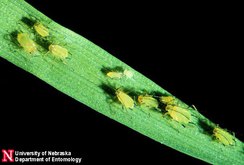

aphids
Aphididae
What do they look like?
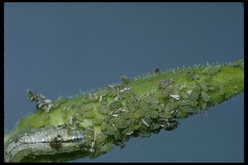
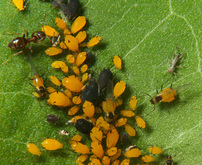
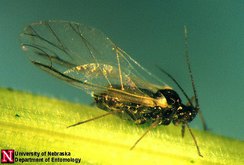
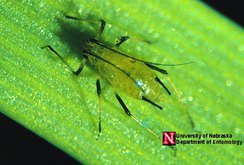
Aphids are very small (only a few millimeters long), soft-bodied insects. They have two little tubes at the end of the abdomen called cornicles. They have small eyes, and sucking mouthparts. They are often green, but may be red, black or brown. They move slowly, and don't jump or hop. They usually have fairly long antennae.
- Other Physical Features
- ectothermic
- bilateral symmetry
- Sexual Dimorphism
- female larger
Where do they live?
There are many thousands of species of aphids around the world, and there are probably around 250 species in Michigan. Adult aphids with wings are so small they can float on the wind, and be carried long distances.
- Biogeographic Regions
- nearctic
- palearctic
- oriental
- ethiopian
- neotropical
- australian
What kind of habitat do they need?
Aphids are almost always found on or near their food plants. If they can they sometimes hide in the curls of leaves. Anywhere there are plants there are aphids.
- These animals are found in the following types of habitat
- temperate
- tropical
- terrestrial
- Terrestrial Biomes
- tundra
- taiga
- desert or dune
- chaparral
- forest
- rainforest
- scrub forest
- mountains
How do they grow?
Aphids have incomplete metamorphosis: young aphids look a lot like adults, but don't have wings. Aphids often have complicated life cycles: an adult female can produce daughters without mating, and each of her daughters can do the same thing, so their populations grow fast. But as the season progresses, some produce sons and daughters that have wings, and these mya fly to new or different food plants. They mate and produce eggs that survive the winter and hatch the next spring. The hatchlings may reproduce without mating, and then their offspring move back to the original host plant species.
- Development - Life Cycle
- neotenic/paedomorphic
How long do they live?
Aphids live a few weeks to a few months.
How do they behave?
Aphids are often found in groups. They reproduce fast and don't move unless they need to. They feed day and night. Winged aphids can fly, but they are so weak that all they can do is lift up into the air, they can't fly against the wind. They are so small that they can drift high in the sky. Some have been collected thousands of feet up, and they can drift on the wind for hundreds of miles.
How do they communicate with each other?
Aphids communicate mainly with chemicals, though they may use touch and sight as well.
What do they eat?
Aphids are herbivores. They suck plant juices out of the leaves, stems, or roots of plants. The juices they drink often have much more sugar than protein. Aphids have to drink so much sugary juice to get enough protein that they excrete a lot of the sugar. They don't need it. The sugary fluid they excrete is called "honeydew", and many other insects feed on it.
- Primary Diet
- herbivore
What eats them and how do they avoid being eaten?
Aphids hide, and if they detect a predator, they produce a chemical that warns other aphids who smell it. They try to walk or fly away. Some aphids produce chemicals that taste bad, or grow waxy threads that make them hard to eat.
-
- Known Predators
-
- lady beetles
- flower fly larvae
- parasitic wasps
- small spiders
- ants
- thrips
- mites
What roles do they have in the ecosystem?
Aphids are important enemies of plants, and are food for many small insects and other invertebrates.
- Some ants feed on the sugar excreted by the aphids. They protect the aphids, and sometimes even keep them in their nests for the winter and put them on new plants in the spring.
Do they cause problems?
Aphids are one of the worst groups of pests on plants. They damage plants directly by feeding on them, and they also carry plant diseases from plant to plant. There can be millions and millions of aphids in a farmer's fields.
- Ways that these animals might be a problem for humans
- crop pest
Are they endangered?
No aphids are known to be in danger of extinction.
-
- IUCN Red List [Link]
- Not Evaluated
Some more information...
Aphids are sometimes called greenflies.
Contributors
George Hammond (author), Animal Diversity Web.


BioKIDS home | Questions? | Animal Diversity Web | Cybertracker Tools
Hammond, G. . "Aphididae" (On-line), Animal Diversity Web. Accessed April 27, 2024 at http://www.biokids.umich.edu/accounts/Aphididae/BioKIDS is sponsored in part by the Interagency Education Research Initiative.
It is a partnership of the University of Michigan School of Education, University of Michigan Museum of Zoology, and the Detroit Public Schools. This material is based upon work supported by the National Science Foundation under Grant DRL-0628151.
Copyright © 2002-2024, The Regents of the University of Michigan. All rights reserved.
